fBox Rack hosts up to eight VST3 plugins, in series or in parallel, with a coloured preamp at the input, a full mix bus section, and a console output stage at the other end.
It is not just a plugin host. It is a complete console channel. The preamp colours your input. Your plugins do the processing. The mix bus shapes the combined signal with summing, EQ, compression and saturation. The console stage colours the output.
Fill the slots with fBox plugins and the whole chain runs on one modelling engine from input to output. Fill them with the plugins you already own and those start sounding like they belong in the same room. It hosts any VST3, ours or anyone else's. Three do not go into a slot: fTape, because the bus saturation and the console output stage both have a Tape mode of their own, and fBox Console and the Rack itself, because a host cannot sit inside itself. Drop it on a track, a group bus or the master, and you have a channel strip that would once have taken a rack of hardware and a desk to build.
The highlighted stage is yours to fill
The preamp responds to how hard you drive it, and the console stage responds to the level arriving from the mix bus. Push more in and you get more colour at each stage, so the input trim is a character control as much as a level control.
Every stage after the preamp starts switched off. Load it up, leave everything bypassed, and it is a clean plugin host. Bring the stages in one at a time and it becomes a channel.
Four sections, each with its own set of voices
After all of that sits a latency-matched global mix, so you can blend the whole processed chain against the untouched input for parallel processing of everything at once, plus an output trim and a safety limiter that is always there.
Put it on a vocal, a guitar, a drum bus. Load fPre, fComp and fEq into the slots, or your own favourites, and let the preamp and console stage do what a desk does around them. One plugin instead of six.
Summing, bus EQ, bus compression and saturation in the order you would find them on a desk. Use it on a stem bus for cohesion, or across the mix for weight.
Set slots to parallel and each one works on its own copy of the signal before they sum back together. The global mix then blends the whole chain against your dry input, latency matched, so nothing smears.
fComp, fEq, fPre, fSat, fMod, fVerb, fDelay and fDrone all load straight into the slots. Every one of them carries its own character, so a rack full of fBox is a rack of units that exist nowhere else.
If you want the whole desk rather than one channel, that is fBox Console: thirty-two of these signal paths side by side, with group buses, a master section, an automation system and a 16-track tape machine. The Rack is the same thinking applied one track at a time, and it runs in any VST3 host.
Every rack is different. Keep the one you like.
Every instance is minted with its own serial number and its own character, the small manufacturing differences that make this unit sound like this unit and no other.
On the Rack that character runs the length of the signal path. One rack's preamp breaks up a touch sooner. The EQ bands sit at slightly different centre frequencies. The compressor grabs transients at its own threshold and breathes with its own timing. The summing bus has its own resonance and crosstalk, the saturation its own warmth, and even the noise floor takes a different colour. No single one of those is obvious on its own. Together they are what gives a rack its voice.
Every new instance can be a different unit, or it can be the one you have chosen to keep. The Rack button in the header is where you decide.
Saved units live in your Documents folder, a folder per product, so you can find them, back them up and copy them between machines.
A unit is the character. A patch card is the character plus everything you set on top of it. Save a patch card and it carries the unit it was made on as well as the settings, so loading one back gives you a choice: Recall Unit brings that machine back with it, character and all, while Apply Settings Only keeps the unit you are on now and takes just the knob positions.
You cannot choose a unit's character any more than you can choose the character of a real machine. But you can learn it, and you can keep the one you love.
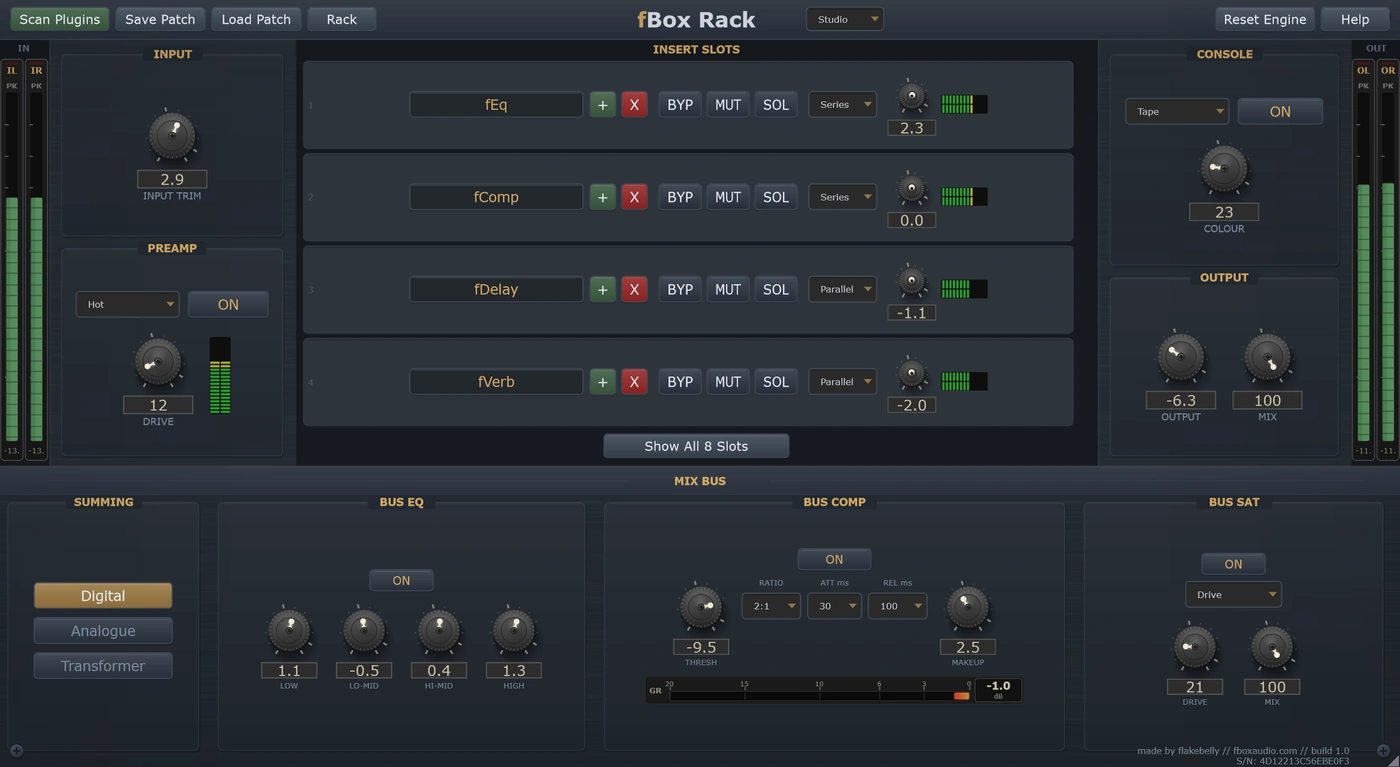
Host any VST3, fBox or third party, apart from fTape, fBox Console and the Rack itself. Per-slot bypass, mute, solo, series or parallel routing, individual level and a level meter.
Clean, Warm, Hot and Valve with a drive control. Colour the input before it reaches your plugin chain, or leave it transparent.
Three summing modes, a 4-band bus EQ, a VCA bus compressor with gain reduction metering, and three saturation modes with a parallel mix.
Five colours for the final stage: Clean, Warm, Punch, Forward and Tape, with one knob for how much of it you want.
Latency-matched blend between your untouched input and the fully processed chain, for parallel processing of everything at once.
Serial-seeded character the length of the signal path. Roll a new one, save the ones you like, and pin your favourite so every instance opens as that rack.
Eco for tracking and dense sessions. Studio for mixing. Master for final mixes and mastering.
Put it on a mono track and nothing is lost. It processes in stereo throughout and the output stays stereo.
14-day free trial included - no payment required
The zip holds the plugin, a one-page start guide and the PDF manual. New to this, or not sure where a .vst3 goes? Read the install guide.
Also available in The Rack Bundle and The Full Studio